Bella Baxter
Poor ThingsBella Baxter first appears as a woman whose past cannot be recovered by ordinary memory. The evidence eventually links her to the name Victoria Hattersley and to a drowning, while Godwin Baxter’s account of her creation supplies a different, startling history for her brain. Neither account reduces her to a passive mystery: she questions her origins, tests the explanations offered to her, and ultimately insists that a life without freedom to choose is not worth having.
Identity and Origins
In Godwin Baxter’s account, the body later known as Bella Baxter was recovered from the River Clyde after a young woman deliberately drowned herself. She had climbed onto the parapet of the St Andrew's Suspension Bridge, dived into the water with her lungs emptied, and tied a reticule filled with stones to her wrist. Her clothes were discreetly fashionable, but their linings had been cut where identifying names or initials might have been sewn. Her wedding and engagement rings had been removed, and the postures of her body revealed a recent pregnancy. To Godwin, those details suggested a woman who intended to disappear, perhaps after being abandoned by a lover or trapped in a marriage she hated.
Godwin places that death within a wider account of social and medical neglect. As a doctor called to examine the body, he had encountered both young women who drowned themselves in poverty and infants whose serious malformations left them unable to live. He describes Glasgow as a place where many parents could not afford a funeral for a dead child. For years, he had planned to unite a discarded body with a discarded brain and create a new life; he says he did so in Bella’s case. The act makes her origins inseparable from questions of medical power and social abandonment, even as the living person who emerges from it becomes more than the experiment’s explanation.
Recovered Past and Competing Accounts
Bella’s own efforts to understand her history encounter a blank where memory should be. In Buenos Aires, she tries to visit her parents’ grave, only to learn that the graveyard has collapsed into a canyon and that the remains have been reduced to dust. Godwin takes her instead to a house he says she once shared with her parents. Its dusty courtyard, cracked water tank, vine, and scrawny chickens prompt her to stare and strain for recognition, but she cannot remember the place. The old caretaker calls her Bella Señorita, while Godwin’s questioning establishes that her parents had been migrants who moved from place to place. Their unsettled life gives her a possible family history without restoring a personal past.
That uncertainty becomes public when General Sir Aubrey de la Pole Blessington appears and claims that Bella is his lawful wife, Victoria Blessington, born Victoria Hattersley. He presents Blaydon Hattersley as her father. Blaydon recognizes her as his daughter, but Bella looks at both men with interest and recognizes neither. Archibald McCandless understands the disturbing division implicit in the encounter: Bella is seeing the father of her brain in the first husband of her body, and the grandfather of her brain in the father of her body. The revelation connects her to a former marriage and family while confirming that those connections do not return the memories that would make them hers.
The competing accounts also shape how others try to define her. A lawyer’s denunciation turns her into the White Daemon, a recurring destroyer of men, and accuses Godwin of manipulating her. Its extravagant accusations are not equivalent to Bella’s own testimony or to the later medical reports; they reveal the interpretive battle around her, in which men convert her sexual independence and unusual origins into evidence for their preferred story.
Learning, Judgment, and Work
Medical reports from a world tour describe Bella as sane, strong, cheerful, and vigorously independent despite amnesia caused by an injury to her skull and the loss of an unborn child. The reports say that she has no memories from before her arrival with Godwin, but that her balance, sensory discrimination, recollective powers, intuition, and logic are unusually keen. During the winter of 1880–81, when she was learning to read, her delight in synonyms, assonance, and alliteration sometimes approached echolalia. The doctors differ over what this linguistic intensity means: Professor Jean-Martin Charcot thinks the loss of childhood memories may have enlarged her intelligence by making her relearn things when old enough to think about them; other specialists expect the verbal habit to diminish as she acquires more memories. The reports say that it does.
Bella’s account of Godwin’s idea of God shows how her developing mind works with what she has been taught. She understands God as a name for everything, from ordinary objects to dreams, animals, ideas, and bodily processes, and gives special importance to movement because it continually makes new things. Her examples range from dead dogs becoming maggots and daisies to ingredients becoming biscuits and reproductive cells developing into a baby. The breadth of the idea sits beside a strikingly sheltered view of human society: she believes that history’s cruelty belongs to the past, assumes that the poor may simply be lazy, and imagines that her dead parents must have been old. She has been told that she lost a baby, but believes that her little daughter is safe because Godwin cares for sick animals and would surely care for a lost child. The gap between her expansive account of movement and her incomplete grasp of suffering becomes harder to sustain as she encounters the world.
In Alexandria, the change is made through what she sees rather than through an abstract argument. At a hotel veranda, she watches nearly naked people, mostly children, gather for coins thrown by wealthy diners; men with whips then drive the crowd apart while the diners laugh or look away. A thin, one-eyed girl carries a baby blind in both eyes. Bella crosses the space and tries to give the girl money, but someone snatches her purse before she can do so. She embraces the girl and baby and struggles back through the crowd. The encounter breaks through her earlier assumption that cruelty and poverty belong safely to the past. It also gives personal force to her fear that the child she was told she lost might be among the vulnerable children before her.
Marriage, Travel, and Recognition
Bella’s relationships expose the different expectations others bring to her. In Glasgow, Archibald McCandless proposes while she is preoccupied with the mystery of her parents and what she was doing during their travels. She treats the proposal as a change of subject, not as an answer to her question. Later, in Gibraltar, she and Duncan Wedderburn arrange the sale of his Scottish Widows and Orphans shares because they need money. As they walk through the Alameda Gardens, a well-dressed woman recognizes Bella as the wife of General Blessington. Bella responds that people usually know her as Bella Baxter when she is not with Wedderburn. The name the stranger supplies does not make the former identity familiar to her; it shows instead how easily other people mistake recognition for knowledge.
After Bella returns to Glasgow, the difference between the woman she once was and the person she has become is tested in front of the men who claim authority over her. General Sir Aubrey de la Pole Blessington calls her his wife, and Blaydon reaches toward her as his daughter, but neither can provide her with memories. Blaydon later admits that he sent her away because he could not bear the prospect of women giving birth. Although he had told her to return to her husband, he confesses that he wanted her out of his sight. Bella credits General Sir Aubrey de la Pole Blessington with driving her away from his house and also acknowledges the part Dolly Perkins played in that separation. The disclosure reveals that her route out of the marriage was shaped by other people’s failures, but it does not make her return to their control.
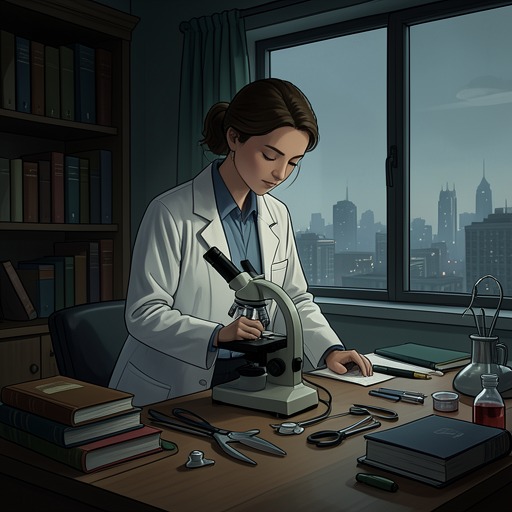
On 10 January 1884, Archibald McCandless and Bella Baxter sign a civil marriage contract by special licence at 18 Park Circus, where both live with their witnesses, Godwin Baxter and Ishbel Dinwiddie. Bella signs as a spinster of the Barony Parish. Godwin dies at the same address on 16 April that year, from a seizure attributed to hereditary neural, respiratory, and alimentary dysfunction. He leaves his entire estate to Dr. and Mrs. McCandless. On 2 September 1886, the woman who married under the name Bella Baxter enrols in the Sophia Jex-Blake School of Medicine for Women under the name Victoria McCandless. The change of name does not erase her earlier life; it records her entry into medical study under the identity attached to her marriage.
Choice and Narrative Significance
When Bella returns to 18 Park Circus, Archibald is there with Godwin. Her face is more gaunt and lined than before, but she recognizes the house and notices the pearl in her travelling-coat. She finds the gobstoppers preserved in a lidded crystal vase, takes one, and declares them the token of her commitment before asking for food. Her return brings the history of her travels into the domestic room, but the objects there do not simply restore her to an earlier self: the mended coat and the preserved sweets mark a home she can now assess for herself.
In the confrontation over her identity, Bella thanks Blaydon for giving her life, while pointing out that he did not bear its physical cost. She thanks General Sir Aubrey de la Pole Blessington for releasing her from her father and driving her from his house, and Godwin for mending her and giving her a home that is not a prison. She chooses to stay with Godwin and describes Archibald as a companion who shares affection with her while leaving her free to work each day. Her final decision is not a recovery of the woman others claim she was; it is a judgment about the life she wants now.
Bella’s history is told through evidence that does not settle into a single uncomplicated biography: a doctor’s account of a deliberate drowning and experimental creation, her own uncertain search for memory, medical reports, a lawyer’s hostile theory, and the documents recording her marriage and later enrolment. The discrepancies make identity a matter of both bodily history and present choice. Bella remains connected to the woman called Victoria Hattersley, but her inability to remember that past does not cancel her capacity to judge the people who invoke it. Her decisive achievement is to make the future, rather than the recovered name, the ground on which her identity rests.